
Breaking Down a PH Vacation Leave Accrual Matrix Formula — Section by Section
A production Philippine vacation leave accrual matrix formula, walked through block by block — DEFAULT handling, DBIs versus input values, the l_process flag pattern, the monthly frequency guard, and the three-phase accrual logic with its one-time January credit.
A full Absence Accrual Matrix formula, taken apart one block at a time. It implements Philippine vacation leave rules, but the patterns underneath — defaults, the process flag, date arithmetic, one-time credits — carry over to any accrual formula you’ll write.
What Even Is an Accrual Matrix Formula?
Oracle Absence Management has several formula types. This one is an Absence Accrual Matrix Formula.
The absence plan already has a matrix table configured — a grid with bands based on years of service, grade, or similar. The matrix engine calculates an accrual value and passes it to your formula as IV_ACCRUAL. Your formula either accepts that value or overrides it.
Here we ignore IV_ACCRUAL entirely and calculate our own. That’s the point of a matrix formula: you get a hook to intercept and customise.
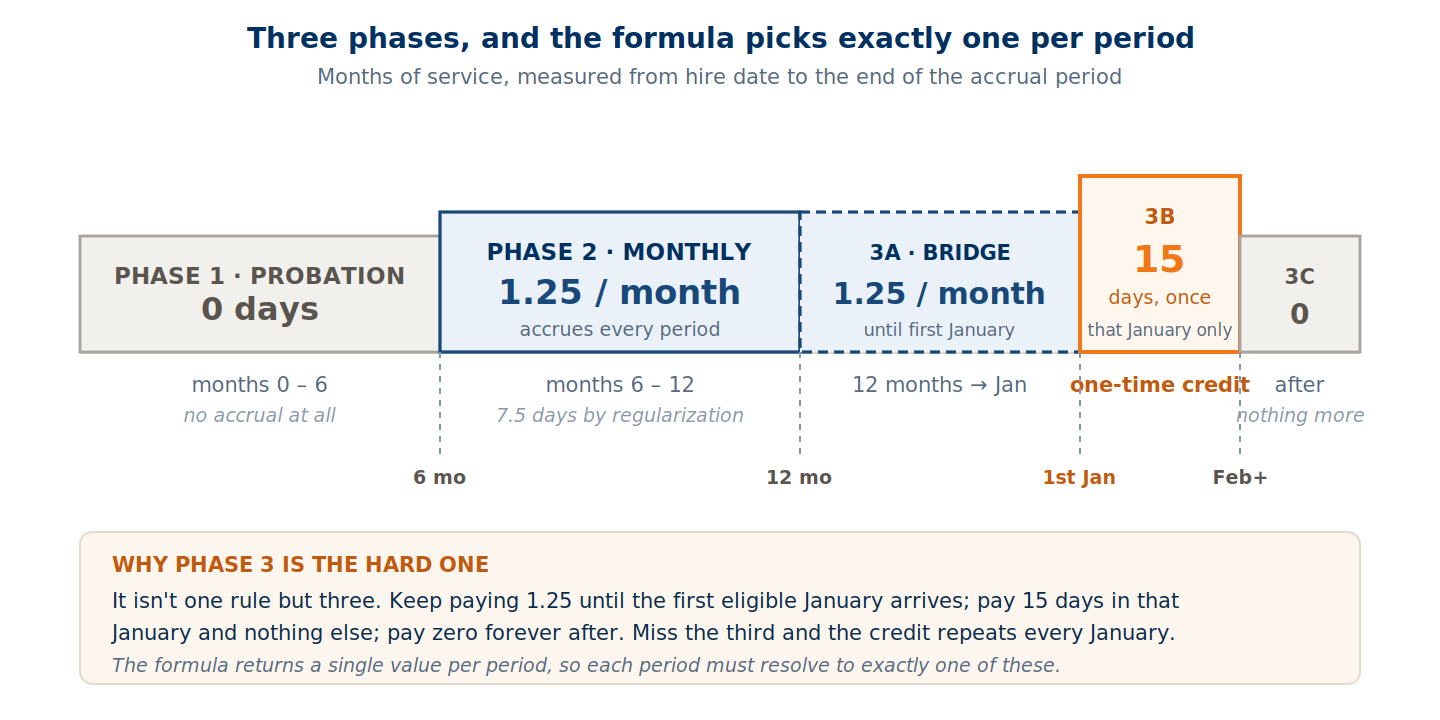
The rules being implemented:
The Header Block
/*************************************************************
FORMULA NAME: PH_VACATION_LEAVE_ACCRUAL_MATRIX
FORMULA TYPE: Absence Accrual Matrix Formula

DESCRIPTION: Philippine Vacation Leave Accrual Matrix Formula
  - First 6 months (probation): No accrual
  - Month 6 to 12: Accrue 1.25 days per month
  - Post regularization (12 months), from subsequent
    January: 15 days credited ONE TIME only
  - If regularized in January, credit that same January
  - After the one-time credit, no further accrual

VERSION: 13.2

REFERENCE: Oracle HCM Cloud Absence Management
Fast Formula Reference Guide (pages 15-19)
This formula overrides IV_ACCRUAL from the matrix
engine with custom phase-based calculation.
*************************************************************/
It’s a comment block, but don’t skip it. It records the formula type — which determines the available inputs and returns — the business rules, the doc reference, and the processing frequency the formula assumes. That last one matters: there’s a guard for it further down.
DEFAULT Statements — Why They Exist in FF
/* DBI defaults - HR_ASSIGNMENT_ID context available */
DEFAULT FOR PER_ASG_REL_ORIGINAL_DATE_OF_HIRE     IS '4712/12/31 00:00:00' (date)
DEFAULT FOR PER_ASG_REL_ACTUAL_TERMINATION_DATE   IS '4712/12/31 00:00:00' (date)
DEFAULT FOR PER_ASG_STATUS_USER_STATUS            IS 'NA'
DEFAULT FOR PER_ASG_FTE_VALUE                     IS 1
DEFAULT FOR ANC_ABS_PLN_NAME                      IS 'NA'

/* Input value defaults per Oracle doc page 16-17 */
DEFAULT FOR IV_ACCRUAL                    IS 0
DEFAULT FOR IV_CARRYOVER                  IS 0
DEFAULT FOR IV_CEILING                    IS 0
DEFAULT FOR IV_ACCRUAL_CEILING            IS 0
DEFAULT FOR IV_ACCRUALPERIODSTARTDATE     IS '4712/12/31 00:00:00' (date)
DEFAULT FOR IV_ACCRUALPERIODENDDATE       IS '4712/12/31 00:00:00' (date)
DEFAULT FOR IV_CALENDARSTARTDATE          IS '4712/12/31 00:00:00' (date)
In Fast Formula there is no null. If a database item or input value returns nothing and you haven’t declared a DEFAULT, the formula errors at runtime. Not a warning — a hard error, and the ESS process marks that employee as failed.
So DEFAULT is mandatory for every DBI and every input value you reference.
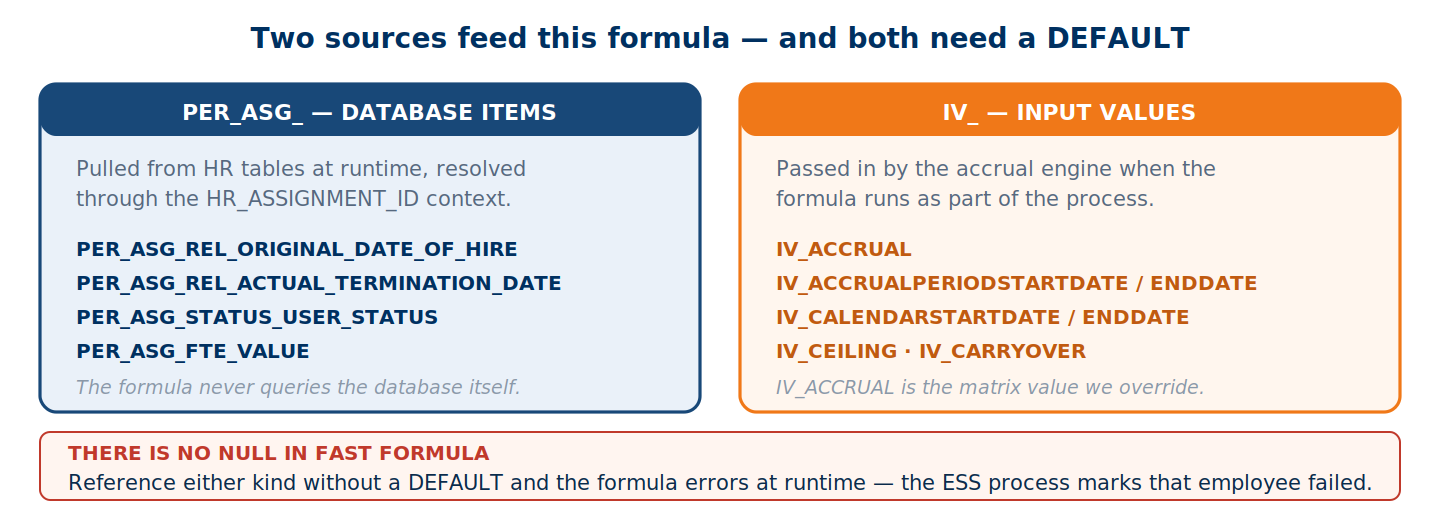
The 4712/12/31 date. This is Oracle’s “end of time” constant, used across all Oracle products to mean “no value” for a date.
DEFAULT FOR PER_ASG_REL_ACTUAL_TERMINATION_DATE IS '4712/12/31'means: if the employee has no termination date — they’re active — use 4712/12/31 rather than crashing.
INPUTS ARE — Declaring What the Engine Passes In
INPUTS ARE
  IV_ACCRUAL,
  IV_CARRYOVER,
  IV_CEILING,
  IV_ACCRUAL_CEILING,
  IV_ACCRUALPERIODSTARTDATE        (DATE),
  IV_ACCRUALPERIODENDDATE          (DATE),
  IV_CALENDARSTARTDATE             (DATE),
  IV_CALENDARENDDATE               (DATE),
  IV_PLANENROLLMENTSTARTDATE       (DATE),
  IV_PLANENROLLMENTENDDATE         (DATE),
  IV_EVENT_DATES                   (DATE_NUMBER),
  IV_ACCRUAL_VALUES                (NUMBER_NUMBER)
You must list every input, even the ones you never use. Pages 16–17 of the Reference Guide list what’s available per formula type.
Note the type declarations — (DATE) on date inputs, (DATE_NUMBER) and (NUMBER_NUMBER) on arrays. Numbers need nothing; FF assumes numeric. Forgetting (DATE) is a common beginner compilation error — FF treats the input as a number and the compile fails.
| Input | What it is |
|---|---|
IV_ACCRUAL | The value the matrix engine pre-calculated. We override this. |
IV_ACCRUALPERIODSTARTDATE / ENDDATE | The current processing period, e.g. Jan 1 to Jan 31 |
IV_CALENDARSTARTDATE / ENDDATE | The plan’s calendar year bounds |
IV_PLANENROLLMENTSTARTDATE / ENDDATE | When the worker enrolled in the plan |
IV_CEILING / IV_CARRYOVER | Plan limits — declared, unused here |
IV_EVENT_DATES / IV_ACCRUAL_VALUES | Array inputs — declared, unused here |
Initialization — Variable Setup and Context DBIs
/*=============== INITIALIZATION ===============*/
l_debug_flag = 'Y'

accrual   = 0
l_process = 'Y'

l_acc_st_dt    = IV_ACCRUALPERIODSTARTDATE
l_acc_end_dt   = IV_ACCRUALPERIODENDDATE
l_cal_st_dt    = IV_CALENDARSTARTDATE
l_cal_end_dt   = IV_CALENDARENDDATE
l_enroll_st_dt = IV_PLANENROLLMENTSTARTDATE

l_abs_plan_name = ANC_ABS_PLN_NAME
l_person_id     = GET_CONTEXT(PERSON_ID, 0)
l_assignment_id = GET_CONTEXT(HR_ASSIGNMENT_ID, 0)

/* PER_ASG_ DBIs - HR_ASSIGNMENT_ID is a context */
l_hire_date  = PER_ASG_REL_ORIGINAL_DATE_OF_HIRE
l_term_date  = PER_ASG_REL_ACTUAL_TERMINATION_DATE
l_asg_status = PER_ASG_STATUS_USER_STATUS

l_acc_st_month = TO_NUMBER(TO_CHAR(l_acc_st_dt, 'MM'))
l_acc_st_year  = TO_NUMBER(TO_CHAR(l_acc_st_dt, 'YYYY'))
GET_CONTEXT() retrieves values Oracle sets before the formula runs. For absence formulas, PERSON_ID and HR_ASSIGNMENT_ID are always available. The second argument is the fallback if the context isn’t set.
The PER_ASG_ items are assignment-level DBIs. They work because HR_ASSIGNMENT_ID is a context — Oracle uses it to know which assignment to pull.
Date extraction pattern. FF has no “get month from date” function. The workaround is
TO_CHARwith a format mask to get a string, thenTO_NUMBERto make it an integer.'MM'gives 01–12,'YYYY'gives the four-digit year. You’ll use this constantly.
l_process starts as 'Y'. FF doesn’t support early returns — you can only RETURN at the very end — so a flag variable controls flow instead. Each validation can set it to 'N', and everything downstream checks it first. It’s the FF equivalent of a guard clause.
ESS_LOG_WRITE — The Only Debugging Tool You Have
IF (l_debug_flag = 'Y') THEN
(
  l_log = ESS_LOG_WRITE('Starting PH Vacation Leave accrual matrix calculation')
  l_log = ESS_LOG_WRITE('Person ' || TO_CHAR(l_person_id)
        || ', assignment ' || TO_CHAR(l_assignment_id)
        || ', plan ' || l_abs_plan_name)
  l_log = ESS_LOG_WRITE('Hire date ' || TO_CHAR(l_hire_date, 'DD-MON-YYYY'))
  l_log = ESS_LOG_WRITE('Assignment status ' || l_asg_status)
)
No debugger, no breakpoints, no console. ESS_LOG_WRITE writes a line to the Enterprise Scheduler job output log, and that’s the whole toolkit.
You must assign the return to a variable. You cannot call
ESS_LOG_WRITE('...')as a standalone statement — FF requires every function call to be assigned.l_logis a throwaway; its value is never used.
|| joins strings. TO_CHAR converts numbers and dates for concatenation, and takes a format mask for dates. Wrapping all logging in IF (l_debug_flag = 'Y') means you turn it off in production by changing one variable.
Monthly Frequency Guard — A Defensive Pattern
/*=============== MONTHLY FREQUENCY GUARD ===============*/

l_period_days = DAYS_BETWEEN(l_acc_end_dt, l_acc_st_dt) + 1

IF (l_period_days < 28) THEN
(
  l_process = 'N'
  IF (l_debug_flag = 'Y') THEN
  (
    l_log = ESS_LOG_WRITE('This formula requires monthly processing, current period is '
          || TO_CHAR(l_period_days) || ' days, skipping')
  )
)
DAYS_BETWEEN is exclusive, hence the + 1 — Jan 1 to Jan 31 returns 30, but the period is 31 days.
Why the guard exists: this formula assumes monthly processing and returns 1.25 days per period. Configure the plan to run weekly and the employee gets 1.25 days per week. The check rejects anything under 28 days — February being the shortest month.
Worth reusing. If your formula assumes a frequency, validate it. Note that it logs the actual period length, which is what makes the misconfiguration diagnosable.
Eligibility Checks — Cascading Flag Pattern
/*=============== ELIGIBILITY ===============*/

/* Check 1: Hire date exists */
IF (l_process = 'Y' AND
    l_hire_date = TO_DATE('4712/12/31 00:00:00', 'YYYY/MM/DD HH24:MI:SS')) THEN
(  l_process = 'N'  )

/* Check 2: Period is after hire date */
IF (l_process = 'Y' AND l_acc_end_dt < l_hire_date) THEN
(  l_process = 'N'  )

/* Check 3: Not terminated before period */
IF (l_process = 'Y' AND
    l_term_date < l_acc_st_dt AND
    l_term_date <> TO_DATE('4712/12/31 00:00:00', 'YYYY/MM/DD HH24:MI:SS')) THEN
(  l_process = 'N'  )

/* Check 4: Assignment is active */
IF (l_process = 'Y' AND l_asg_status <> 'ACTIVE') THEN
(  l_process = 'N'  )
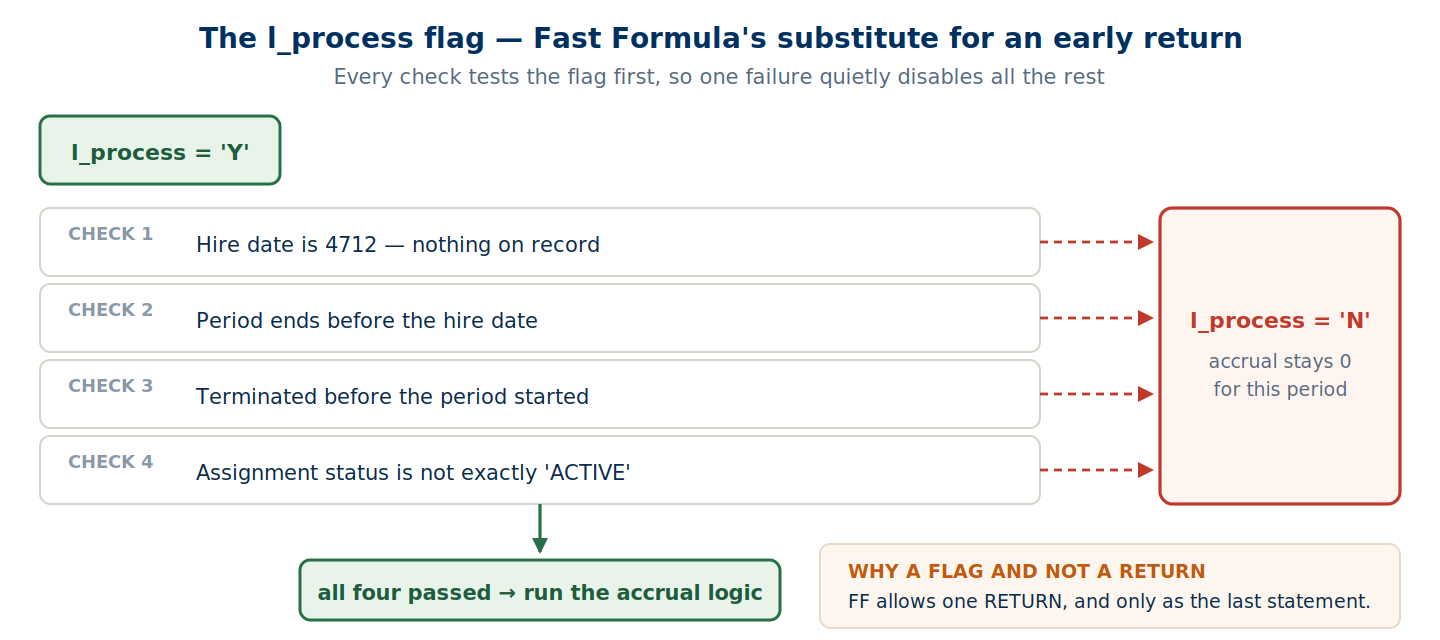
Four checks, one pattern. Each tests l_process = 'Y' first, so once any check fails the rest are skipped automatically.
Check 3’s second condition is the critical one. Without l_term_date <> 4712/12/31, you’d be comparing the “no termination” default against the period start for every active employee — and every one of them would fail.
Check 4 is case-sensitive. FF string comparison is exact. If your instance uses 'Active' or 'Active - Payroll Eligible', this fails for everyone. Verify the exact string in your setup.
TO_DATE()format masks must match the string exactly.'YYYY/MM/DD HH24:MI:SS'against'4712/12/31 00:00:00'.HH24is 24-hour time. Wrong mask, runtime error.
Accrual Logic — The Core Calculation
/*=============== ACCRUAL LOGIC ===============*/

IF (l_process = 'Y') THEN
(
  l_months_of_service = MONTHS_BETWEEN(l_acc_end_dt, l_hire_date)
)
This is where IV_ACCRUAL gets overridden. MONTHS_BETWEEN returns a decimal — hired 15 Mar with a period ending 15 Sep gives exactly 6; ending 10 Sep gives about 5.83.
Phase 1 — Probation, under 6 months
IF (l_months_of_service < 6) THEN
(
  accrual = 0
  /* Employee is still in probation, no vacation accrual */
)
Phase 2 — Monthly accrual, 6 to 12 months
IF (l_months_of_service >= 6 AND l_months_of_service < 12) THEN
(
  accrual = 1.25
  /* Accruing 1.25 days this period */
)
The formula runs once a month and returns 1.25, so the engine accumulates it. Six months at 1.25 gives 7.5 days by regularization.
Phase 3 — Post-regularization, 12 months and beyond
The complex one. It has three sub-phases, and the first job is working out which January gets the credit.
l_reg_date  = ADD_MONTHS(l_hire_date, 12)
l_reg_year  = TO_NUMBER(TO_CHAR(l_reg_date, 'YYYY'))
l_reg_month = TO_NUMBER(TO_CHAR(l_reg_date, 'MM'))

/* If regularized IN January, credit that same January
   Otherwise credit the following year January */
IF (l_reg_month = 1) THEN
(  l_first_jan_year = l_reg_year  )
ELSE
(  l_first_jan_year = l_reg_year + 1  )

l_first_jan_date = TO_DATE('01/01/' || TO_CHAR(l_first_jan_year), 'DD/MM/YYYY')
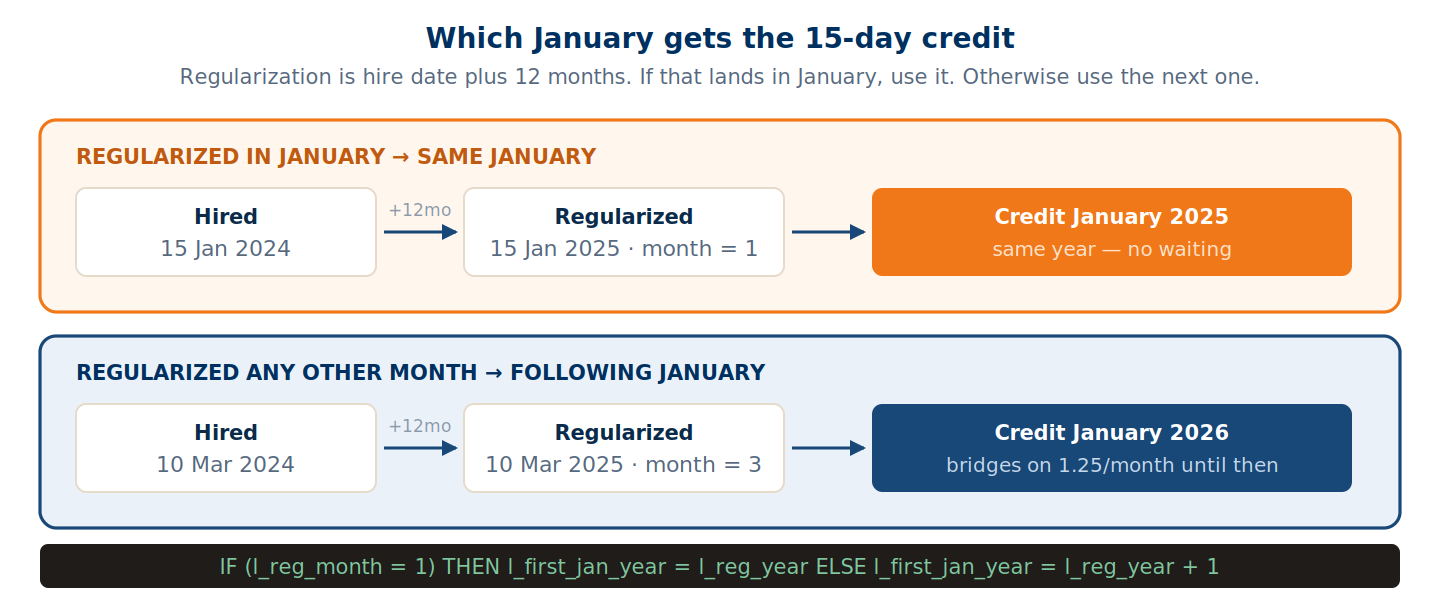
| Hire date | Regularization date | First eligible January |
|---|---|---|
| Jan 15, 2024 | Jan 15, 2025 | January 2025 |
| Mar 10, 2024 | Mar 10, 2025 | January 2026 |
| Dec 1, 2024 | Dec 1, 2025 | January 2026 |
3A — the bridge. Between regularization and that first January, keep accruing 1.25 a month:
IF (l_acc_end_dt < l_first_jan_date) THEN
(
  accrual = 1.25
  /* First January not reached yet, continuing monthly 1.25 days */
)
3B — the one-time lump sum. Only in the first eligible January. Both period start and end must fall in that same January:
IF (l_acc_st_month = 1 AND
    l_acc_st_year  = l_first_jan_year AND
    l_acc_end_month = 1 AND
    l_acc_end_year  = l_first_jan_year) THEN
(
  accrual = 15
  /* One-time January credit: 15 days */
)
3C — nothing afterwards. Without this the credit would repeat every January:
IF (l_acc_end_year > l_first_jan_year OR
    (l_acc_end_year = l_first_jan_year AND l_acc_end_month > 1)) THEN
(
  accrual = 0
  /* One-time 15 day credit was already given, no further accrual */
)
RETURN — The Formula Output
/*=============== SINGLE RETURN per Oracle Doc page 19 ===============*/

IF (l_debug_flag = 'Y') THEN
(
  l_log = ESS_LOG_WRITE('Returning accrual ' || TO_CHAR(accrual))
)

RETURN accrual
Accrual matrix formulas return one numeric value named accrual. The engine adds it to the worker’s balance for the period.
One RETURN, and it must be the last executable statement. No early returns. That constraint is exactly why the whole formula runs on the
l_processflag and a chain of independentIFblocks.
FF Syntax Things to Remember
| Rule | Detail |
|---|---|
= does everything | Assignment and comparison — context decides which. There is no ==. |
| Parentheses required | IF (condition) THEN ( statements ). Drop the parens around the body and it won’t compile. |
No ELSE IF | Nest an IF inside ELSE, or use independent IF blocks with a flag. There is no ELSIF. |
| Strings are case-sensitive | 'ACTIVE' <> 'Active'. Verify the exact value in your setup. |
| Functions must be assigned | Even void-like ones. l_log = ESS_LOG_WRITE(...). |
|| is concatenation | Not logical OR. Logical OR is the word OR. |
RETURN must be last | No early returns. Use flags for flow control. |
| No semicolons | Line breaks and parser context determine statement boundaries. |
Wrapping Up
That’s the whole formula. The concepts it covers: DEFAULT handling, DBIs versus input values, GET_CONTEXT, date manipulation via TO_CHAR / TO_NUMBER / TO_DATE / ADD_MONTHS / MONTHS_BETWEEN / DAYS_BETWEEN, ESS_LOG_WRITE debugging, the process-flag pattern, and RETURN behaviour.
If you’re new to Fast Formula, type this out in the formula editor rather than pasting it. The syntax patterns stick faster that way.
Abhishek Mohanty · Oracle ACE Associate | AIOUG Member | Oracle HCM Cloud Consultant & Technical Architect — Fast Formulas, Absence Management, Time & Labor, Core HR, Redwood, HDL, OTBI.